

Quick answer: most people searching "Pollo AI vs Higgsfield" are actually asking two different questions. If you want one dashboard that runs your prompts through Sora, Veo 3.1, Kling, Seedance, and dozens of other engines, Pollo AI is the broader, easier tool. If you're directing shots — orbiting a character, repeating the same camera move across twenty scenes — Higgsfield was built for exactly that job. And there's a third path worth knowing about: Pixmax pairs similar model variety with script-to-video production tools, and it has been undercutting both on price for most of this summer. Here's how it all shakes out.
Pollo AI vs Higgsfield at a Glance
| Pollo AI | Higgsfield AI | |
|---|---|---|
| In one line | Multi-model hub built for volume creators | Cinema-first suite built for directed shots |
| Core strength | Model variety, effects, ad & commerce studios | Camera moves, lenses, character consistency |
| Model catalog | 100+ engines incl. Sora, Veo, Kling, Seedance, Runway, plus house models | Curated flagship set wrapped in director-style controls |
| Beyond video | Talking avatars, voiceover, sound effects, marketing & commerce studios | Cinema Studio, Shorts Studio, viral presets, influencer tools |
| Team workflow | Parallel tasks on paid plans; API access | Multi-studio workspace; reusable shot grammar |
| Learning curve | Low — first clip in minutes | Moderate — controls pay off after setup |
| Entry price* | Free credits; paid from ~$10/mo (annual billing) | From ~$9/mo |
| Pick it if | You ship many social or ecommerce variants weekly | The camera move is the creative idea |
*Checked August 2026 through third-party test data; both platforms meter by credits that vary by model and resolution, so confirm live pricing before paying.
Which Should You Choose? Match the Tool to Your Job
Running social accounts or shipping trend content every week?
Start with Pollo AI. Reels hooks, meme formats, avatar clips, UGC-style ads — this is assembly-line work, and Pollo's template library treats it that way. One underrated habit the platform makes painless: generate the same prompt through two or three different engines before committing real credits. Five minutes of comparison settles brand-style questions faster than any review ever will.
Directing shots rather than prompting them?
Higgsfield earns its learning curve. Fashion films, music-video inserts, recurring-character campaigns — anywhere the same visual grammar has to survive scene after scene, its shot-design layer does work that prompt-only tools rarely sustain. Once a camera recipe clicks, you reuse it instead of re-describing it from scratch every time.
Selling products online?
Honestly, either works, so let credits decide. Both platforms handle product ads, virtual try-on visuals, and UGC promos well enough that output quality stops being the deciding factor. What separates them is which credit pool survives your retry rate. That's the variable almost nobody covers properly, so let's get into it.
Output Quality: The Engine Matters Less Than You'd Think
After going through every community thread and third-party test I could find, here's the pattern that keeps repeating: neither platform owns better raw quality, because both rent access to largely the same flagship engines. What differs is process.
Higgsfield makes you stage the shot deliberately — camera path, lens feel, lighting — before you generate, so results stay consistent across a project. Pollo's quality swings with whichever model you pick; a draft-tier engine and a premium cinematic engine under the same subscription can produce clips that look like they came from different products.
Pollo AI vs Higgsfield Test: E-Commerce Product Ad Video
Test prompt: e-commerce product ad video
A matte black perfume bottle rotates slowly on a marble pedestal, with soft studio lighting, a smooth 180-degree product orbit, fine water droplets on the glass, and a luxury commercial look.
Pollo AI
To keep the Pollo AI vs Higgsfield comparison fair, I used the same e-commerce ad prompt, a 4-second video length, 720p resolution, 16:9 aspect ratio, and each platform's own video model. The screenshots and output below show the real workflow and result, so you can judge which AI video generator fits product ads better.
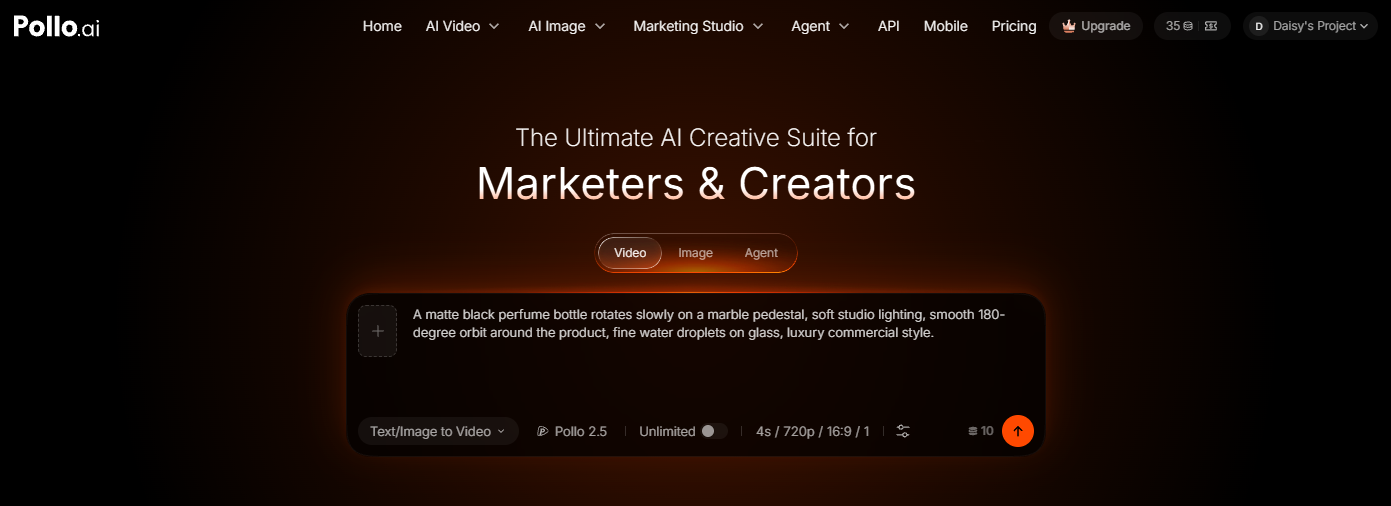
During generation, Pollo AI showed pop-up interruptions, which made the product video workflow feel less smooth.
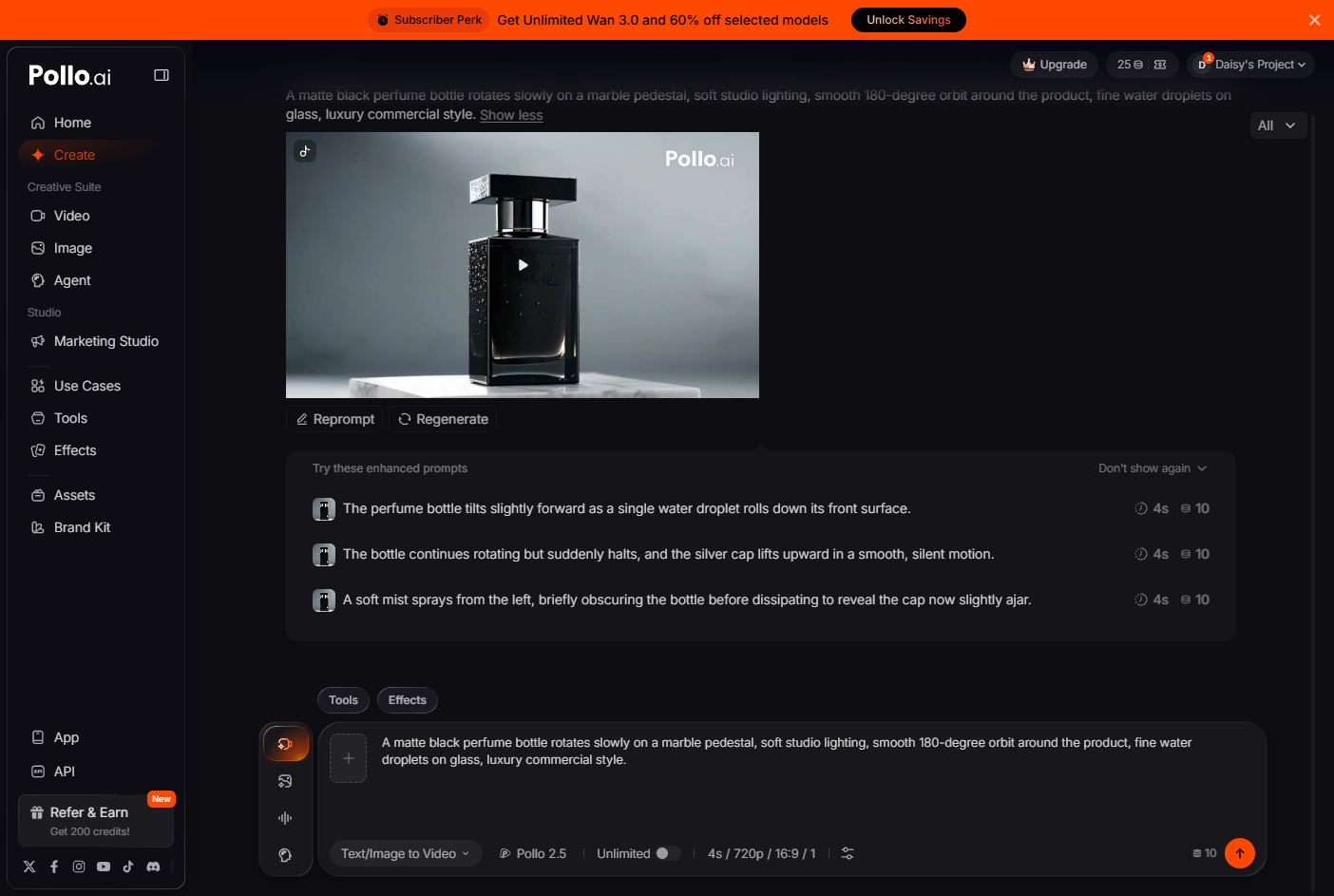
The free version is also limited for commercial use: downloaded videos include a Pollo AI watermark, so brands that need clean product ads will likely have to upgrade to Premium.
Higgsfield AI
Orbit is one of Higgsfield's signature camera presets. Running the same perfume-ad prompt shows why camera control matters: Higgsfield understands a clean product orbit more reliably than a generic text-to-video workflow.
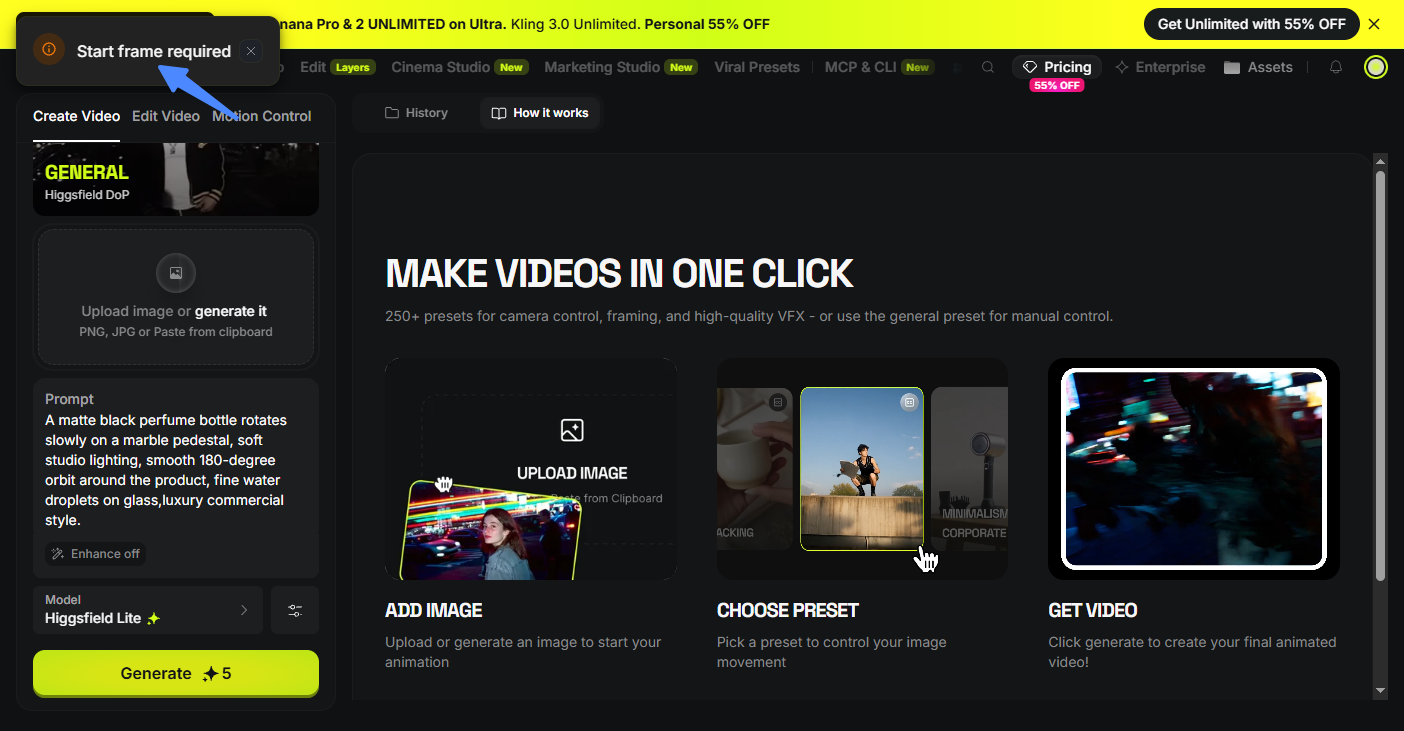
Higgsfield's process is different — it renders a reference frame from the product-ad prompt first, then generates video from that frame.
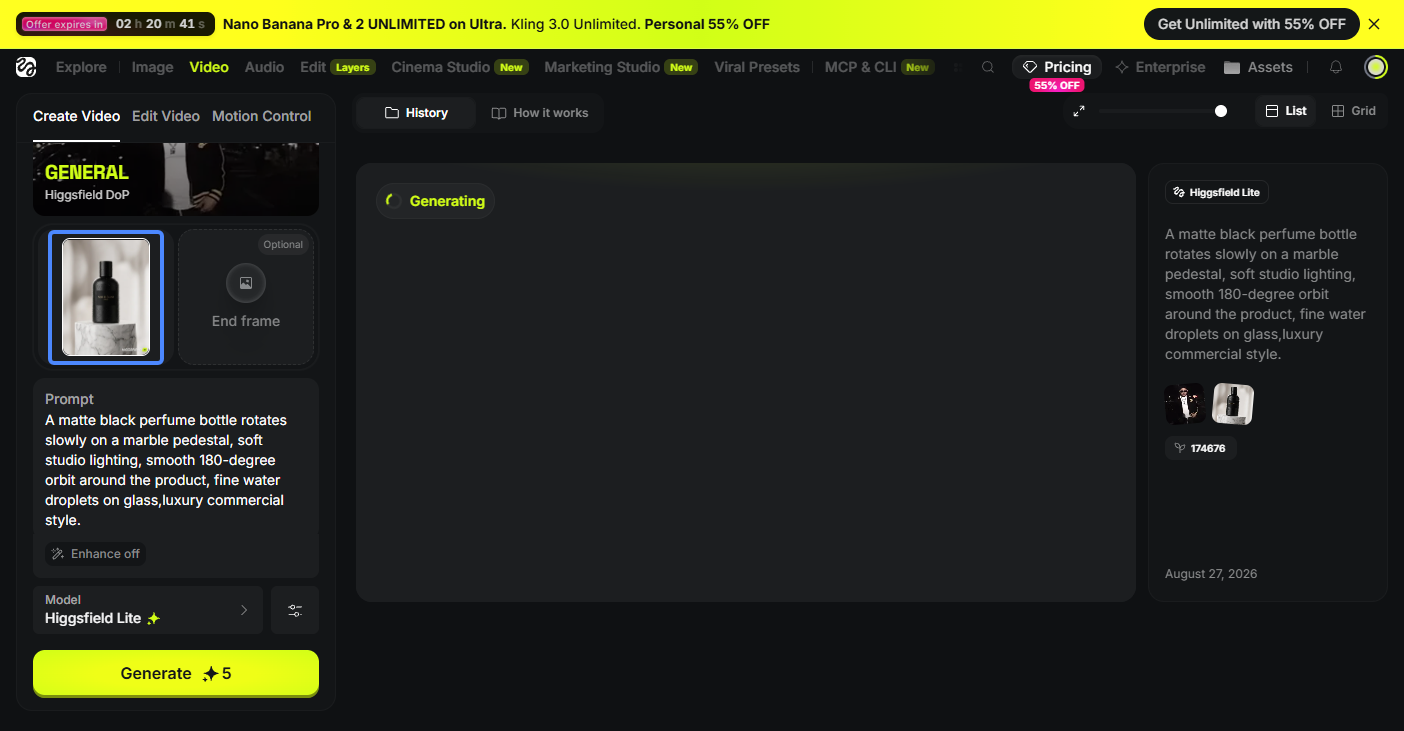
I used the same prompt as Pollo AI. Because of Higgsfield's model settings, this test could not match every parameter exactly: the output defaulted to 5 seconds and did not allow the same 16:9, 4-second setup. Even with that caveat, the final product video still fell short of expectations and looked weaker than the Pollo AI result in this test.
Two practical takeaways from that research. First, the underlying model often matters more than the platform wrapper, which is why a dedicated Seedance vs Veo 3 breakdown is worth reading before you commit to either tool. Second, borrow the template trick from r/HiggsfieldAI workflow threads: lock motion strength, lighting keywords, and one action per clip instead of rewriting prompts every time. Users report it keeps outputs consistent and stops credits leaking away on retries.
The Real Cost Isn't the Sticker Price
This is the paragraph most comparison posts skip, and it's the only one that determines your actual bill. Entry prices on both platforms sit within a dollar of each other, which makes the subscription cost noise and consumption the real signal. So forget monthly fees for a second and calculate cost per usable clip: run one representative brief, record the visible credit estimate, count failed attempts and upscales, then divide plan price by accepted outputs.
A worked example (August 2026 community data): an r/PromptEngineering test compared four hubs at their popular ~$29–30 tier and counted roughly 600 Nano Banana Pro images, ~120 Kling 2.6 clips, and ~41 Veo 3.1 generations on Higgsfield — against materially fewer equivalents elsewhere at the same price. Same sticker, very different value.
Three traps catch people out regardless of platform. Monthly credits that expire unused (Pollo AI's pricing FAQ confirms there's no rollover). Premium models that burn several times the credits of draft models. And failed generations you still pay for. An unlimited-model promotion can flip the entire math in a given month, so always check what's currently unlimited before subscribing anywhere.
What Users Complain About
Feature tables don't tell you what breaks after week three. Community threads do. Higgsfield users in r/HiggsfieldAI discussions consistently praise how fast new flagship models land and how smoothly the multi-tab workflow runs — while criticizing aggressively pushy marketing tactics. Both things are true at once. If that combination bothers you, skim a fuller Higgsfield AI review collecting Reddit and Trustpilot feedback before you auto-renew an annual plan.
Across both platforms, the same complaints surface again and again: unpredictable credit burn, face consistency drifting on cheaper models, occasional generation or billing glitches. Plans and model lineups change monthly, so treat all of this as weather reports rather than permanent facts. One rule of thumb holds either way — keep 20–30% of your credits in reserve for retries.
When Neither Wins on Price: Meet Pixmax
If reading this far feels like choosing which bill to pay, Pixmax comes at the problem from a third angle. It's an all-in-one workspace running leading models — wan 3.0, Seedance 2.5, Kling 3.0 Omni, Veo 3.1, GPT Image 2, ElevenLabs audio — on top of production infrastructure neither rival bundles natively. Paste a script, get characters, scenes, and storyboards auto-generated; tweak each shot on an infinite canvas; export social-ready video with voiceovers and captions. Their script-to-storyboard guide shows how the pipeline handles character consistency shot to shot, which is exactly the pain point that pushes most teams toward multi-tool workarounds in the first place.
I use the same prompt on Pixmax to generate an e-commerce perfume ad video:
Unlike Pollo AI's pop-up interruptions, Pixmax's interface stayed clean throughout generation.
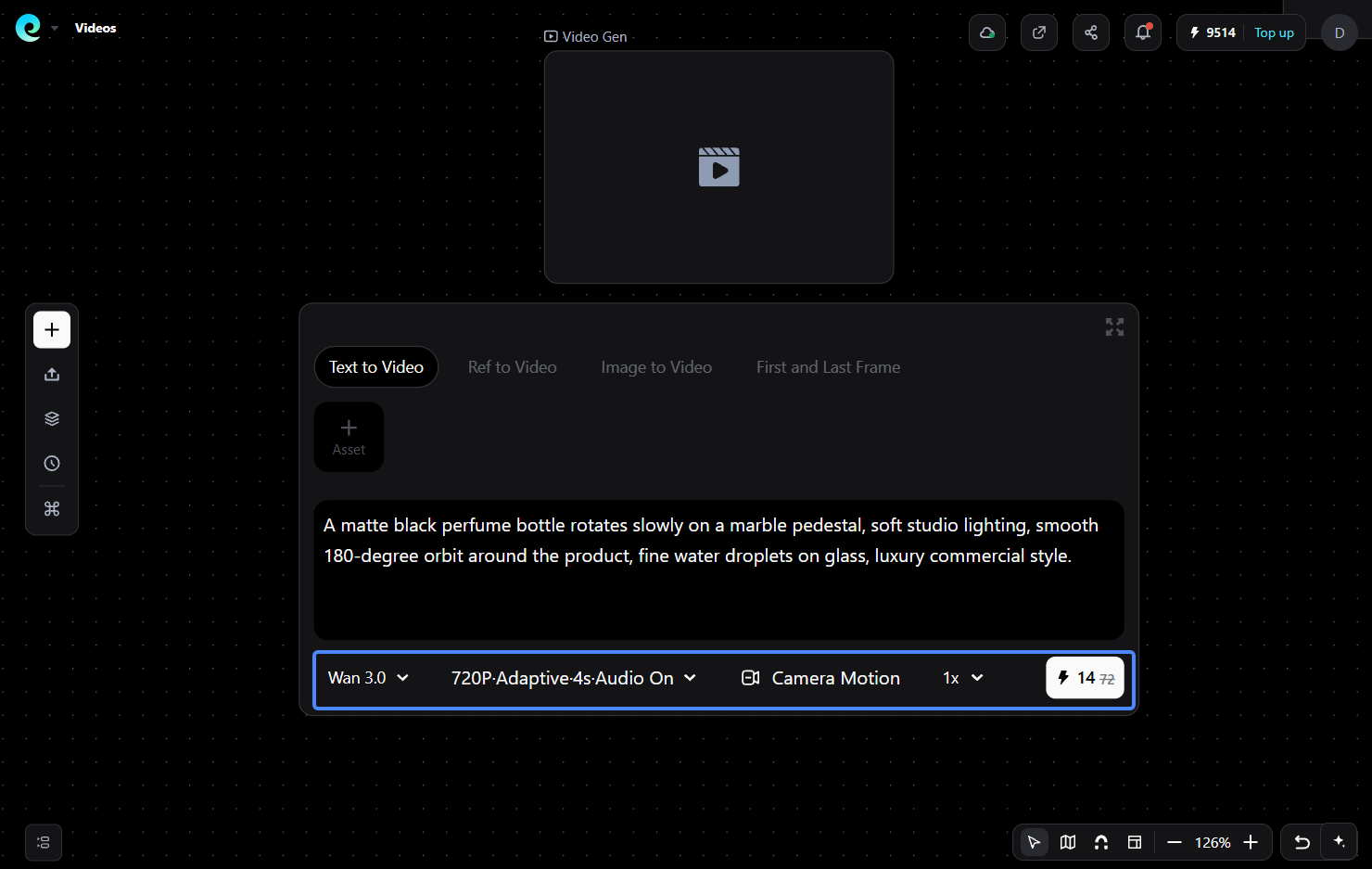
Here is the video. In this test, the Pixmax output looked cleaner than both the Pollo AI and Higgsfield results.
Then there's the price side, where Pixmax has been genuinely aggressive. Rolling model-level discounts looked like this when I checked the offers page:
| Active offer (checked Aug 2026) | Discount | Ends |
|---|---|---|
| WAN 3.0 video generation | 80% off | Aug 27 |
| Seedance 2.0 Mini | 60% off | Sep 7 |
| Seedance 2.5 1080p | 28% off | Sep 17 |
| Early-bird subscription | up to 50% off | limited |
Two structural details matter more than any single promotion. Separately purchased credits never expire, unlike the monthly-reset allowances on both platforms above. And the catalog refreshes fast — Wan 3.0, Seedance 2.5, GPT Image 2, and Midjourney V8.2 all showed up as fresh additions within weeks of release. There's also a referral program worth up to 2,000 credits, plus 3,000–10,000 credit rewards for publishing workflows. If you want Pollo-style breadth plus Higgsfield-style structure on one bill, try Pixmax free — no credit card required.
How to Test Before You Pay
Whichever platform you lean toward, run this five-minute check first:
- Write one representative brief you'd actually ship — not a demo prompt.
- Generate it on each free tier, including one premium model.
- Record credits spent per attempt, including failures and upscales.
- Divide plan price by accepted outputs to get your true cost per clip.
- Read the rollover, watermark, and refund terms tied to your specific plan.
FAQ
Is Pollo AI or Higgsfield better for beginners?
Pollo AI, usually — fewer decisions stand between prompt and finished clip. Higgsfield rewards patience: once you learn its camera system, directed shots become faster than re-prompting.
Which platform is cheaper overall?
Entry pricing is nearly identical; total cost depends on model choice and retry rate. During current promotions, Pixmax's model-level discounts (up to 80% off select engines) undercut both on specific models — verify end dates before subscribing.
Do unused credits roll over?
Generally no. Pollo's pricing FAQ confirms monthly credits reset each cycle, while Pixmax sells separately purchased credit packs that never expire. Read the terms attached to your plan.
Is Higgsfield worth it in 2026?
Yes, if directed camera work is central to your content — community consensus credits it with the fastest access to new flagship models despite aggressive marketing. For casual meme-style clips, a cheaper hub makes more sense.
Does Pollo AI have a free plan?
It offers a small free credit allowance (around 20 credits per third-party checks in August 2026) — enough for a few low-cost tests before committing to a paid tier.
Can I use Pollo AI and Higgsfield together?
Yes — a multi-model hub for daily volume plus Higgsfield for hero shots is a common professional stack. If managing two subscriptions feels heavy, Pixmax consolidates model access and production tooling in one place.
Verdict
Strip away the feature lists and the Pollo AI vs Higgsfield choice is really about how you like to work: direct the shot with Higgsfield, or compare engines at volume with Pollo AI. Run one identical brief through both free tiers before you pay anyone — and if credit economics end up deciding it for you, Pixmax's current discounts make the strongest case on the board. Thanks for reading.