

Quick Answer:
Yes, Higgsfield AI is worth it for creators who want access to many top video models (Kling 3.0, Sora 2, Veo 3.1, Seedance, Soul V2) under one subscription, and it has a real — but deliberately thin — free tier of roughly 10 credits per day with watermarked 720p output.
It is not worth it if you expect literal "unlimited" generation, fast human support, or predictable refunds: heavy users report credit burn, throttling, generation failures, and a Trustpilot score of around 3.2/5.
Before you pay, decide by your usage volume — and if your goal is a complete script-to-video production pipeline rather than single clips, a workflow agent like Pixmax is the more powerful method, and the alternative worth testing in 2026.
This Higgsfield AI review covers what the platform actually is, whether the free plan is real, how the credit system and refund policy really work, what Reddit and Trustpilot users say, the best Higgsfield alternative — and — if you need finished videos from scripts — the one method worth trying in 2026.
What Is Higgsfield AI?
Higgsfield AI is a cloud-based AI video and image generation platform that bundles 30+ third-party and proprietary models — including Kling 3.0, Sora 2, Veo 3.1, Seedance, Nano Banana, and its own Soul and DoP (Director of Photography) models — behind one subscription and one interface.
Unlike single-model tools, Higgsfield positions itself as a "multi-model hub": instead of maintaining ten separate accounts, you generate video and images from different engines inside one dashboard, and its Cinema Studio gives you camera-level control (focal length, lens type, stacked camera moves) that most competitors only approximate. The platform also ships a genuinely useful mobile app, 70+ effects, 80+ one-click "apps" (face swap, lipsync, virtual try-on, topic-to-video), and plugins for Adobe Premiere Pro and DaVinci Resolve.
My honest take: the model breadth is real, and the camera-motion strength is the most-cited reason creators stick with it. What most reviews understate is that the platform's value depends entirely on your generation volume — a point that becomes clear in the pricing section below.
How Higgsfield AI Works
Higgsfield's workflow is credit-based, not time-based. Every generation — video or image — draws from your monthly credit pool, and the cost depends on which model, resolution, and length you choose. Premium models consume dramatically more: several reviewers report a single cinematic generation costing 60–90 credits, while turbo models like Soul V2 and Seedance Fast are cheap enough for pre-visualization drafts.
Two mechanics matter more than the headline features:
- Credits do not roll over. Unused credits expire at the end of your billing cycle, and top-up credit packs expire after about 90 days.
- "Unlimited" plans are metered in practice. Several paid tiers advertise unlimited model access, but users report throttling during high-traffic periods and a "battery" system that can lock you out of unlimited mode until you pay for extra access.
This is the single biggest gap between marketing and experience, and it shows up repeatedly in the community sources below.
Is Higgsfield AI Free?
Yes, Higgsfield AI has a free tier, but it is intentionally thin: roughly 10 credits per day (about a few image generations), watermarked output capped at around 1k/2k, and flagship models locked behind paid plans.
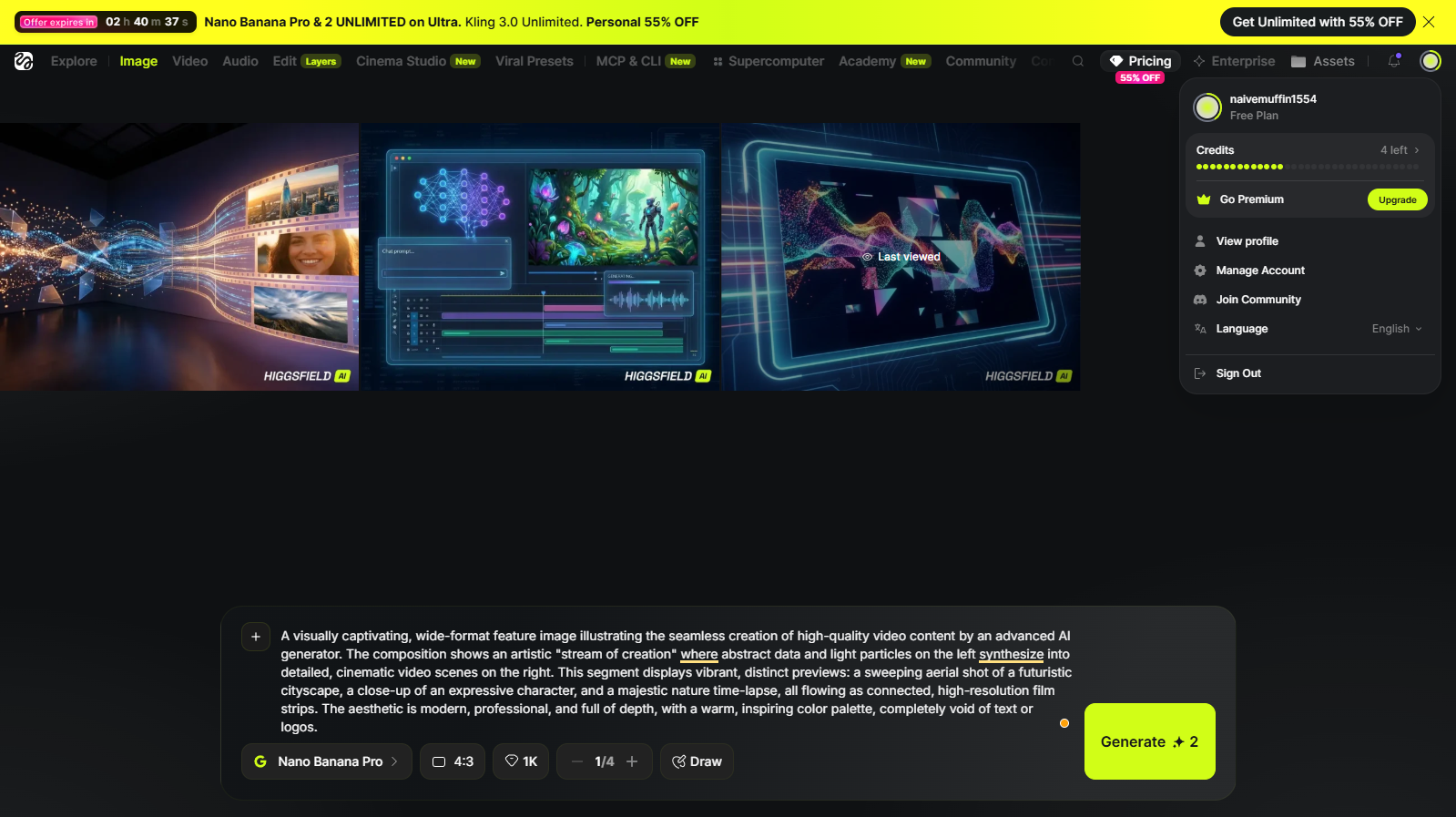
As of mid-2026, verified pricing trackers describe the free tier as a "forever free" account with limited daily credits, and Higgsfield has also run promotional free access — including a 7-day unlimited trial on select models like Kling 3.0 and Nano Banana 2 — but promotional terms rotate and are best confirmed on the official pricing page.
The free plan is a test drive, not a workflow. If you only need a few clips a month, it works. If you plan to produce content regularly, the math changes quickly — which brings us to pricing.
Higgsfield AI Pricing in 2026: What It Really Costs
Higgsfield retired its old Basic/Pro/Max tiers in early 2026 and now sells Starter, Plus, and Ultra plans. Verified pricing sources (July 2026) put the range at:
| Plan | Monthly (approx.) | Typical credits | Best for |
|---|---|---|---|
| Free | $0 | ~10, watermarked | Testing the platform |
| Starter | $19 | ~270 fixed | Light, first-time creators |
| Plus | $39–59 | ~1,200 | Regular producers (most common recommendation) |
| Ultra | $70–129 | 3,000–9,000 | Agencies, heavy generation |
Prices differ slightly across trackers and change with promos, so treat this as a range, not a quote — always check the official pricing page before buying.
The hidden costs most reviews skip
Three cost realities rarely appear on the marketing page:
- Per-clip cost is steep on premium models. At 60–90 credits per cinematic generation, a Starter plan can be spent in 3–5 days of heavy testing, per several reviewer and community reports.
- Refunds are narrow. Per Higgsfield's own published terms and its responses on Trustpilot, refunds apply only to the initial purchase, requested within 7 days, with zero credits used, and a service fee of up to 6% may be deducted. Renewals, credit packs, and upsells generally do not qualify.
- Credits expire. No rollover means paying for volume you don't use is wasted.
What Real Users Say: Reddit, Trustpilot, and BBB
Community and review-platform sentiment is the most honest pricing signal, and it is genuinely mixed.
Reddit (r/HiggsfieldAI and r/generativeAI): Users consistently praise generation speed and camera control — "made my first video in minutes" is a recurring theme. But the same communities document recurring downtime: one thread reported generations failing for hours, with users describing "80% of generations either fail or stall forever," and a detailed 4-month user write-up argues that the "unlimited" tier is throttled by a battery system and that running Kling through Higgsfield cost more than a direct Kling subscription. Others report a late-2025 ban wave that froze accounts without warning.
Trustpilot: Higgsfield sits around 3.2/5 across roughly 3,700 reviews on Trustpilot — a genuinely mixed score. Positive reviews praise speed, effects, and output quality; negative ones cluster around refunds denied, surprise charges after cancellation, and high credit consumption.
BBB: Complaints filed with the Better Business Bureau echo the same themes, including a denied refund request made 30 minutes after purchase with zero credits used, and billing disputes.
The pattern to trust: the platform's creative output gets consistent praise; its billing and support get consistent criticism. Plan for email-only support (reportedly 36–48 hour response times) and check your statement after cancelling.
Higgsfield AI Pros and Cons
Pros
- 30+ top video models under one subscription — no model-hopping
- Cinema Studio camera control is genuinely strong
- Useful mobile app, 70+ effects, 80+ one-click apps
- Adobe Premiere Pro / DaVinci Resolve plugins and MCP/CLI access
- Frequent model additions that improve an existing subscription
Cons
- Premium models burn credits fast; credits do not roll over
- "Unlimited" tiers are throttled in practice, per multiple user reports
- Email-only support with slow response times
- Narrow refund policy and recurring billing complaints
- Recurring generation failures during outages
- 10–30 second clips mean stitching for longer content
Is Higgsfield AI Worth It?
Higgsfield AI is worth it if you are a creator or marketer producing video regularly and want one subscription instead of ten. The Plus tier (≈$39–59/month) is the sweet spot most reviewers land on: enough credits for real output, full model access, and the camera tools that justify the price.
Higgsfield AI is not worth it if you are a casual user or you expect "unlimited" as advertised. For occasional testing, the free tier suffices. And if predictable billing, fast support, and literal unlimited generation are deal-breakers, the community evidence suggests you will be disappointed.
Use this decision framework:
- Under ~15 generations/month → free tier, skip paying
- 15–100 generations/month → Plus is the value plan
- 100+ generations/month or team production → compare Ultra against a dedicated pipeline tool first
Best Higgsfield AI Alternative: Pixmax vs Higgsfield Compared
If your goal is finished videos from scripts rather than single clips, Pixmax is the strongest Higgsfield alternative in 2026 — it covers the full production pipeline that Higgsfield leaves to manual assembly, and its purchased credits never expire.
Why Pixmax works as an alternative
Pixmax is an all-in-one AI video platform that competes directly on model access (Seedance 2.5, Kling 3.0, Veo 3.1, Hailuo, Vidu, Wan, PixVerse, Nano Banana, GPT Image 2, ElevenLabs voice and more) but differs from Higgsfield in one decisive way: it wraps those models in a production workflow rather than a prompt box.
The Pixmax AI Video Agent takes a script, analyzes story structure and shots, generates storyboards and clips, keeps characters consistent across scenes, and batch-refines output — the four official steps being upload script → smart analysis → AI generation → refine and export. Support for scripts up to 100,000 words makes it a realistic option for episodic series that would otherwise burn dozens of Higgsfield generations.
Pixmax's practical advantages over Higgsfield:
- Automated character consistency — appearance, outfits, and expressions persist across scenes with far less manual adjustment, the single most-cited pain point in episodic AI work.
- Credits that don't waste — Pixmax subscription credits reset monthly, but separately purchased credits never expire, unlike Higgsfield top-up packs that expire after about 90 days.
- Deeper post-production — 4K video upscaling, 1080P image enhancement, subtitle removal, and voice customization are built in.
- Cinematic control with lighting — the AI Cinematic Control panel covers camera bodies, lens brands, aperture, focal length, multi-angle 3D control, and full lighting (color temperature, key light, rim light).
- Team and agency features — shared projects, asset library, real-time collaboration, and Enterprise seat/credit management for studios.
- A cheaper entry point today — free trial without a credit card plus an early-bird subscription discount (up to 50% off, per the Pixmax pricing page).
Where Higgsfield still wins: a larger claimed model roster and more established community tools (mobile app, Premiere Pro/DaVinci Resolve plugins), plus far more independent review data to judge it by.
The honest caveat: Pixmax's "100% character consistency" and "100x production speed" figures are vendor claims on its product page — there is no comparable Reddit or Trustpilot track record yet, so treat them as specifications to verify with its free trial, not verified benchmarks.
How to choose: use the free tiers of both. If you produce 15–100 short clips a month for social, Higgsfield's credit hub is the simpler fit. If you produce scripted content — short dramas, series, ads, or product films — start with Pixmax, because it automates the pipeline where Higgsfield burns your credits fastest.
Higgsfield AI vs Pixmax vs Direct Model Subscriptions
Seedance 2.0 Cost Comparison
For a consistent comparison, we calculated the subscription cost of generating one 4-second, 720p Seedance 2.0 video:
Cost per video = subscription price ÷ included video generations
| Billing and usage level | Higgsfield | Pixmax | Better value |
|---|---|---|---|
| Entry monthly | Not supported | 1.15 | Pixmax |
| Regular monthly | 0.89 | 0.79 | Pixmax |
| Regular annual | 0.7 | 0.67 | Pixmax |
| High-volume monthly | 0.78 | 0.73 | Pixmax |
| High-volume annual | 0.59 | 0.56 | Pixmax |
| Lowest available rate | 0.54 | 0.56 | Higgsfield |
Pricing data collected in June 2026. Plans, promotions, and model availability may change.
Pixmax supports Seedance 2.0 on every personal plan and is slightly cheaper across most comparable tiers. Higgsfield Starter does not support the model, but its largest annual plan achieves the lowest theoretical cost at $0.54 per video.
The price gap is relatively small. Pixmax’s stronger advantage is its script analysis, storyboarding, character consistency, and batch-production workflow, while Higgsfield remains simpler for generating standalone clips.
Prices reflect the supplied subscription data, including Pixmax promotional pricing. Actual costs may be higher because of failed generations and retries.
| Dimension | Higgsfield AI | Pixmax | Direct model subscriptions |
|---|---|---|---|
| Best for | Multi-model clip generation | Script-to-video pipelines | Maximum value from one model |
| Workflow | Generate and edit individual clips | Script → storyboard → render → export | Primarily generation |
| Character consistency | Mostly manual across scenes | Automated across scenes (vendor claim) | Model-dependent |
| Purchased credits | Expire after about 90 days | Never expire | Varies |
| Cinematic control | Camera movements via Cinema Studio | Camera, lens, and lighting controls | Model-dependent |
| Team workflow | Primarily individual creation | Collaboration, shared assets, and enterprise seats | Usually limited |
| Post-production | Limited built-in enhancement tools | 4K upscaling, subtitle removal, and voice tools | Usually limited |
| Independent reviews | Extensive but mixed | Limited verified community data | Varies by provider |
Choose Higgsfield for flexible multi-model clip generation, Pixmax for structured script-to-video production, or a direct subscription when one model consistently meets your needs.
# FAQ
Is Higgsfield AI free?
Yes, Higgsfield AI offers a free tier with roughly 10 credits per day, watermarked 720p output, and restricted model access. It's a test drive, not a production workflow; paid plans start around $15–19/month.
Is Higgsfield AI worth it?
For regular creators and marketers who want multiple top video models under one subscription, yes — the Plus tier is the value sweet spot. For casual users or anyone expecting literal unlimited generation and fast human support, community reviews suggest it isn't.
Does Higgsfield AI's unlimited plan really mean unlimited?
Users on Reddit report throttling and a "battery" system that locks unlimited mode after heavy use, sometimes requiring extra payment. Treat "unlimited" as high-volume, not infinite.
Can I get a refund on Higgsfield AI?
Per Higgsfield's published terms, refunds apply only to the initial purchase, requested within 7 days, with zero credits used, minus a service fee of up to 6%. Renewals and credit packs are generally non-refundable — complaints about this are common on Trustpilot and BBB.
Which Higgsfield plan should I choose?
Under ~15 generations a month, use the free tier. For regular production, Plus (≈$39–59/month) is the most-cited value plan. Agencies with heavy volume should compare Ultra against a full-pipeline tool like Pixmax first.
Is Pixmax better than Higgsfield AI?
For script-driven production — episodic content, ads, or films — yes, Pixmax is the stronger choice: its AI Video Agent automates script breakdown, storyboarding, character consistency, and batch refinement, and its purchased credits never expire. For quick single-clip generation, Higgsfield's model hub is simpler and has far more community review data to evaluate it.
What is the best alternative to Higgsfield AI?
For clip generation, Kling, Runway, and Sora are the raw-quality benchmarks. For complete script-to-video production with automated storyboarding and character consistency, the Pixmax AI Video Agent is the strongest method — and its free tier lets you compare before you commit.
Higgsfield AI Review: Final Verdict
Higgsfield AI delivers the best "many models, one subscription" experience on the market, with genuinely strong camera tools — but its credit economy, throttled unlimited tiers, and billing complaints mean you should buy the plan that matches your actual volume, not the cheapest banner. Use the free tier or a 7-day trial to test output quality first. And if your work is script-driven production rather than single clips, route around the credit burn entirely with a pipeline agent like Pixmax — that is the method that actually changed production speed for episodic creators in 2026.