




Quick answer: Choose Seedance 2.5 Flash when most of your renders get rejected and the final ships at 720p or below. Choose Seedance 2.5 when you need 1080p or 4K, native Draft-to-final approval, more than 20 reference assets, or legible on-screen text.
The numbers: Flash is roughly 34% cheaper per render and about 2x faster, but capped at 720p with 20 reference assets and no Draft mode.
The catch: Flash is not a small Seedance 2.5 — it is the volume tier, not the delivery tier.
What Is the Difference Between Seedance 2.5 Flash and Seedance 2.5?
Seedance 2.5 Flash is the low-cost tier of the same ByteDance Seed family, released on November 12, 2026 and opened to the API on November 15. It is not a new generation.
Both tiers share the same core: text-to-video, first/last-frame control, omni references, native audio, editing, extension, and 4–30s clips.
| Spec | Seedance 2.5 Flash | Seedance 2.5 |
|---|---|---|
| Model ID | `dreamina-seedance-2-5-flash-261115` | `dreamina-seedance-2-5-260628` |
| Max output | 720p, 8-bit | 1080p / 4K, 10-bit H.265 |
| Draft mode | No | Yes (480p draft → 1080p/4K final) |
| Reference assets | 20 (10 images + 5 video + 5 audio) | 50 (30 images + 10 video + 10 audio) |
| Clip length | 4–30s | 4–30s |
| Audio, edit, extend | Yes | Yes |
| Output format | MP4, MOV | MP4, MOV |
Three rows decide most projects: resolution, reference capacity, Draft.
Resolution is a delivery requirement, not a quality setting
Flash stops at 720p. That is fine for TikTok, Reels, Shorts, and internal review.
It is not fine for on-screen text, labels, or small faces. A hands-on test by Zhi Dongxi (reported by ifeng) found background signage losing strokes in fast cuts. At 720p, small glyphs fail before anything else does.
Treat the cap as a content constraint. Upscaling — including the AI Video Enhancer route — adds sharpness, not missing detail.
Reference budget: 20 assets is a character sheet, not a cast
Flash's 10 images sound generous until you allocate them:
- 3 angles of the lead character
- 3 angles of the product
- 2 location plates
- 2 style frames
That is exactly 10. One person, one product, one room.
Add a second character or a third product variant and you are on the flagship. 50 vs 20 references is not a capacity number; it is an org chart.
One caveat cuts the other way: more references create more conflicts. Every asset needs one declared job — identity, product, motion, camera, style, or timing. If it controls none of those, delete it.
Draft mode is the one feature Flash cannot imitate
Flash is faster, so "use Flash as a draft" sounds reasonable. It does not hold up.
A Seedance 2.5 draft returns a task ID. The final inherits that draft's prompt, references, duration, ratio, and audio, so the approved take survives the resolution jump. Copying the same prompt into a fresh Flash run inherits nothing — it produces a new take with new framing and timing.
Flash-as-draft saves render money. It does not save approval work. You review twice.
Price: What "34% Cheaper" Actually Buys
BytePlus list prices for a 5-second 16:9 clip, checked November 2026:
| Output | Seedance 2.5 Flash | Seedance 2.5 | Difference |
|---|---|---|---|
| 480p | $0.34 | $0.514 | −34% |
| 720p | $0.76 | $1.156 | −34% |
| 1080p | Not available | $2.843 | — |
Independent billing confirms the ratio. Segmind's 11-clip test was billed $1.598 for a 10-second 720p clip on Flash and $2.443 on Seedance 2.5 — 34.6% less, measured at the invoice, not the pricing page.
Cost per approved shot beats cost per render
What matters is the cost of output a client accepts:
Cost per approved shot = price per render × attempts
Because Flash costs 65.4% of the flagship, it stays cheaper until it needs 1.53× as many attempts (1 ÷ 0.654). That is the whole decision, reduced to one question: does Flash fail 50% more often on this prompt class?
Early evidence says it depends on the class:
- A same-prompt arena run by Renoise (11 pairs, 480p, AI judge) put Seedance 2.5 first in 8 of 11, including all four text-only prompts. Usable-as-delivered: 9/11 for Flash, 10/11 for the flagship.
- On reference-image shots the gap narrowed to 3–1. On subject swaps it split 1–1.
- Read them as direction: small sample, AI judge, no human re-check.
The hidden line item is review time
A 10-second 720p render saves $0.85 — less than a minute of review.
At a $60/hour loaded rate, 90 seconds of extra review erases the entire saving. Any pipeline with a human review step shrinks that discount below the spreadsheet figure.
Is Seedance 2.5 Flash Really Twice as Fast?
Partly verified: "twice as fast" is a vendor claim, but timings agree.
- Segmind: 82 seconds average for Flash vs 171s for the flagship across two matched 10-second 720p pairs.
- Renoise: median 147s vs 283s across 11 shared prompts.
Two corrections:
- 480p is a cost lever, not a speed lever. Flash at 480p saved roughly 10 seconds (78s vs 88s) in Segmind's test.
- Queue load dominates. Measure your own provider median, not the press release.
Quality: Where Flash Holds and Where It Breaks
Flash's failures cluster in predictable places, so they are testable before you commit.
| Shot type | What independent tests found | Pick |
|---|---|---|
| Multi-shot ad with fixed cut lengths | Flash held cut timing better (3.75s / 3.46s / 2.88s against a 4/3/3 brief) | Flash |
| Dialogue with lip sync | Both placed the line and tracked mouths; Flash transcribed word-for-word | Either |
| Product reference with a person | Flash prioritised the product and changed the stated gender; name the person twice | Either, with prompt discipline |
| Precise fast action (kickflip) | Flash substituted an easier, cleaner trick | Test both, budget retries |
| Small text, labels, signage | Glyphs garble at 720p | Seedance 2.5 at 1080p |
| 480p → 720p on the same seed | Composition re-rolls; pin the look with a first frame | Neither, without a first frame |
The honest read: in matched tests, Flash lost on compliance, not on beauty. When Flash misses a beat, so does the flagship — just less often.
How to Choose: Six Decision Rules
Apply these in order; the first three settle most projects.
- Final ships at 720p or below → Flash. Ad variants, UGC, previs, animatics.
- Any 1080p or 4K deliverable → Seedance 2.5. Do not plan to upscale your way out of the cap.
- A client must approve a specific take → Seedance 2.5 with Draft. This is non-negotiable.
- More than 10 images or a second character → Seedance 2.5.
- On-screen text, labels, faces in wide shots → Seedance 2.5 at 1080p.
- A precise fast physical action → run the exact prompt on both before committing.
The Workflow That Beats Picking One Tier
The cheapest setup is not a model choice but a routing pipeline: one reference library, one review gate.
Pixmax is a practical home for the Seedance 2.5 side of that pipeline:
- Draft is supported and samples last 14 days, per the November 12 update — long enough to run a client review cycle without re-rendering.
- An asset library holds character, product, and style references — no brief rebuild when you switch tiers.
- Timestamp-level editing fixes the failed three seconds instead of the whole take.
- Platform-generated videos get free upscale, handling the 720p finishing step without a second tool.
Run it in five steps:
- Lock one reference per job: identity, product, motion, style.
- Draft at 480p on Seedance 2.5 when approval matters. Keep the draft's task ID.
- Route volume variants to Flash only where 720p is genuinely the deliverable.
- Log attempts per approved clip. That number, not the price page, decides your tier.
- Finish — upscale, denoise, caption — only after approval.
Seedance 2.5 Flash vs Seedance 2.5 on Pixmax
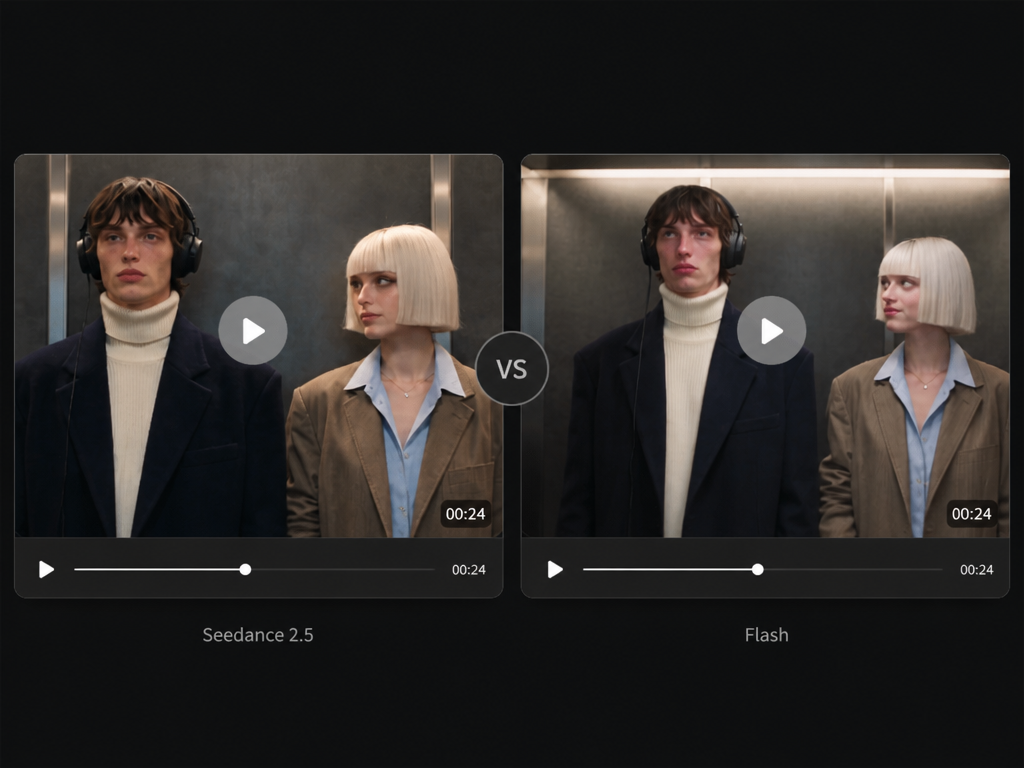
On Pixmax, the same prompt bills 846 credits on Flash at 720p and 345 credits on Seedance 2.5 at 480p. Resolution, not the tier label, sets that bill — and it inverts the usual advice: one Flash render buys 2.45 flagship drafts, and only the draft can be promoted to a 1080p final. Judge the clips below on that basis.
Video A — Seedance 2.5 Flash, 720p · 846 credits | Video B — Seedance 2.5, 480p · 345 credits
FAQs
Is Seedance 2.5 Flash a different model from Seedance 2.5?
No. It is a cheaper tier in the same family (`...flash-261115` vs `...260628`): 720p, 20 reference assets, no Draft mode.
Can I use Seedance 2.5 Flash as a draft for Seedance 2.5?
No. Flash has no draft task, and a new flagship run re-rolls framing and timing. Only a native draft carries approval into the final.
How much cheaper is Flash per clip?
About 34% at 480p and 720p: $0.76 vs $1.156 for 5 seconds at 720p. No 1080p at any price.
Is Flash really 2x faster?
Independent timings land near 2x (82s vs 171s; median 147s vs 283s), but the vendor publishes no benchmark. 480p barely improves speed.
Which handles on-screen text better?
Seedance 2.5 at 1080p. At 720p, small text and signage lose strokes on both tiers.
Is Flash better than Seedance 2.0?
ByteDance positions it above the previous flagship. If you only need 720p drafts, compare it against Seedance 2.0 mini on cost per approved clip.
Bottom Line
Seedance 2.5 Flash wins on throughput and loses on ceiling. Seedance 2.5 wins on delivery and approval, at 34% more per render.
Pick by deliverable: 720p volume goes to Flash, anything a client signs off on goes to Seedance 2.5 with Draft. Then measure attempts per approved clip — that ratio tells you whether the discount is real or deferred.
Thanks for reading. Still deciding between generations rather than tiers? The Seedance 2.5 vs Seedance 2.0 comparison covers the upgrade question; the Seedance 2.5 review covers what the flagship is good at.