

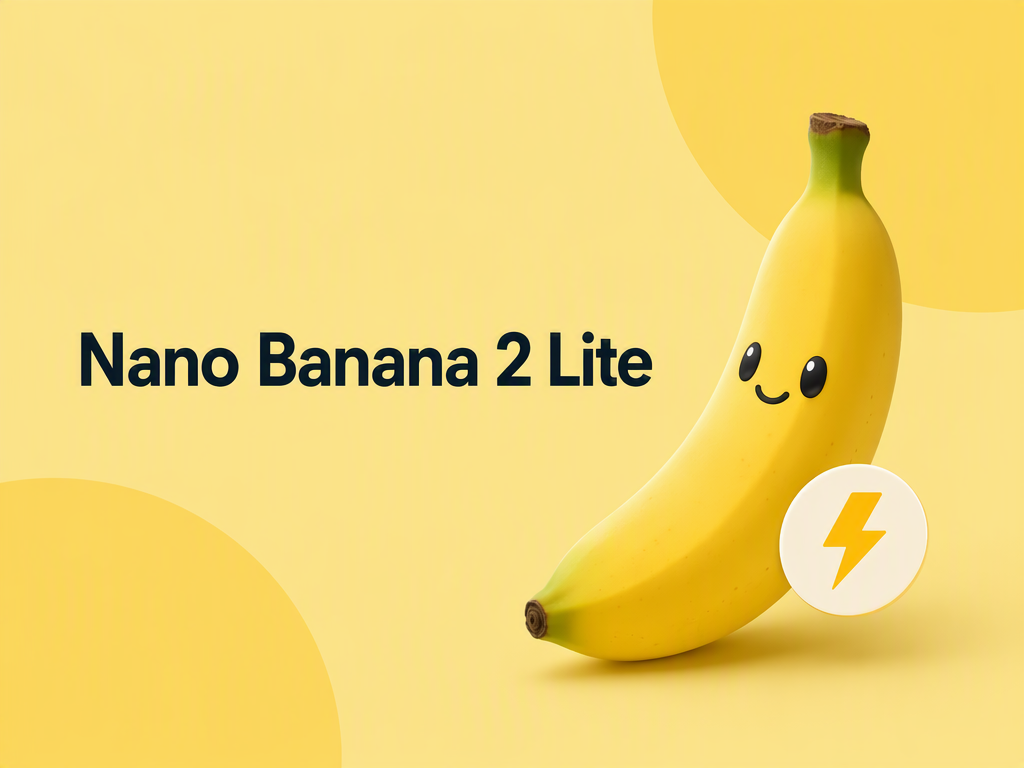
Quick Answer: Nano Banana 2 Lite is Google's fastest and cheapest Gemini image model (Gemini 3.1 Flash-Lite Image). It generates 1K images in about 4 seconds at roughly $0.034 per image, with quality close to full Nano Banana 2 — but it caps at 1K resolution and isn't meant for final print-grade assets. It shines at drafting, ad variants, storyboards, and high-volume pipelines.
You can run it in Google AI Studio, via the Gemini API or fal.ai, inside RunDiffusion, or on Pixmax, which has integrated it into its AI video production workflow.
What Is Nano Banana 2 Lite?
Nano Banana 2 Lite (model ID `gemini-3.1-flash-lite-image`) is the speed-optimized member of Google's Nano Banana image family, released June 30, 2026. In the family lineup, Lite is built for velocity, Nano Banana 2 is the balanced generalist, and Nano Banana Pro handles complex professional control. Google positions Lite as the direct replacement for the original Nano Banana, and it now powers image generation across consumer surfaces like AI Mode in Search, the Gemini app, and Google Photos.
Review: Where It Wins and Where It Doesn't
Speed: the headline claim holds up
Google's own benchmarks put text-to-image at around 4 seconds per 1K image. Independent checks agree: K-Dense measured a 3.8-second median across 240 generated scientific figures, and fal reports sub-2-second latency on its infrastructure. In our view, this is the feature that actually changes behavior — when a generation costs four seconds instead of twenty, you stop rationing ideas and start exploring in bulk.
Quality: close to Nano Banana 2, not identical
Based on the arena.ai Elo scores Google publishes, Lite lands within roughly 19 points of Nano Banana 2 on generation and about 80 points on editing — a gap most viewers won't notice side by side. It also outperforms similarly priced rivals: eesel's analysis of Google's charts shows it beating Flux 2 Klein 9B on quality (1251 vs 1069 Elo) despite comparable pricing. Character consistency, prompt adherence, and legible in-image text carry over from the family. Manus AI runs it in production agents and describes quality as "close to the full Nano Banana 2."
Limitations to know before committing
Per Google's documentation, Lite outputs 1K resolution only, isn't optimized for many-reference compositions or long multi-turn edit chains, and lacks Search grounding. Small faces, dense text, and heavy relighting edits can produce artifacts. Every image carries an invisible SynthID watermark.
Nano Banana 2 Lite vs Nano Banana 2 vs Pro vs GPT Image 2
| Model | Speed (1K) | Price/image | Max output | Best for |
|---|---|---|---|---|
| Nano Banana 2 Lite | ~4s | ~$0.034 | 1K | Drafts, variants, volume |
| Nano Banana 2 | ~20s | ~$0.067 | Up to 4K | Balanced production |
| Nano Banana Pro | ~19s* | Higher | High-fidelity | Complex professional control |
| GPT Image 2 | ~49s* | Usage-based | High | Maximum raw fidelity |
The pattern is clear: Lite trades top-end resolution and fine-detail accuracy for a 5× speed gain at half the price. That's a good trade for iteration, a bad trade for hero assets.
Best Ways to Use Nano Banana 2 Lite (Tested Routes)
1. Google AI Studio & Gemini API — the developer baseline
Google AI Studio is the free playground for testing prompts, and the Gemini API is the official route for building Lite into apps and pipelines. If you're swapping out the original Nano Banana, the change is drop-in. See the official launch post for integration details.
2. fal.ai — serverless access for product teams
fal.ai hosts Lite behind a serverless API with sub-2-second latency, 14 supported aspect ratios, and token-based billing — useful when you want Google's model without managing Google Cloud setup.
3. RunDiffusion — browser workspace for creative teams
RunDiffusion offers Lite inside a browser-based creative workspace, positioned around getting "range before polish": concept exploration, prompt testing, thumbnails, and campaign ideation.
4. Pixmax — the production pipeline for image-to-video creators
Pixmax is an AI creation platform whose AI Video Agent turns scripts into finished videos by orchestrating script analysis, storyboarding, character design, and video generation in one canvas. This is where Nano Banana 2 Lite becomes genuinely strategic: agentic video workflows burn through dozens of storyboard frames and scene stills before a single clip renders, and a 4-second, $0.034 image model is exactly what makes that loop economical.
Pixmax has integrated Nano Banana 2 Lite alongside video models like Seedance, Kling, and Veo 3.1, so you can draft consistent characters and stills with Lite, then animate them without switching tools — with support for scripts up to 100,000 words and batch refinement across scenes.
Try Nano Banana 2 Lite on Pixmax →
Verdict: Which Route Fits You?
Solo developers should start in AI Studio; product teams embedding generation into apps will prefer fal.ai; creative teams exploring directions fit RunDiffusion; and script-to-video creators get the most leverage from Pixmax, where cheap fast images feed a full video pipeline. For final hero or print assets, step up to Nano Banana 2 or Pro.
Our honest take: treat Lite as a drafting engine, not a finishing engine. Community discussion mirrors this split — r/StableDiffusion celebrated the speed, while r/GeminiAI threads still debate whether Lite-tier output is "enough." For most commercial iteration work, it is; the teams losing with Lite are the ones using it for the wrong job.
FAQs
Is Nano Banana 2 Lite free?
Experimentation is free in Google AI Studio's free tier and included in Gemini app surfaces. API usage costs about $0.034 per 1K image.
How does Nano Banana 2 Lite compare to Nano Banana 2?
Lite is ~5× faster (4s vs ~20s) and half the price, with Elo scores within ~19 points on generation. But it outputs 1K only, versus up to 4K. Choose Lite for volume and drafts; choose Nano Banana 2 for finals.
Can Nano Banana 2 Lite generate 4K images?
No. Output caps at 1K resolution. A common workflow is drafting in Lite, then regenerating or upscaling winners in Nano Banana 2 or Pro.
What is Nano Banana 2 Lite best used for?
Rapid ideation, ad variant testing, thumbnails, storyboards, real-time app features, and AI agent pipelines — anywhere latency and cost matter more than maximum resolution.